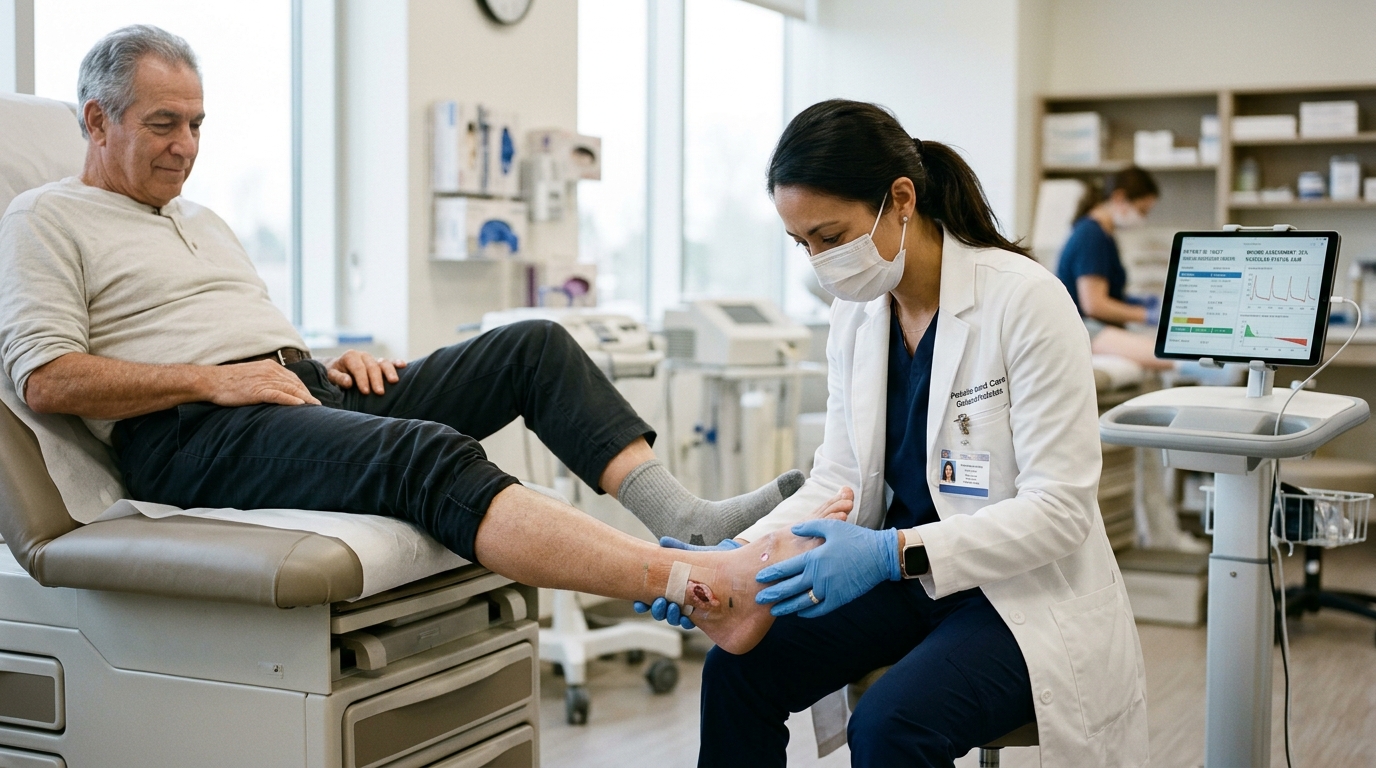

Diabetic foot ulcer treatment in the US rests on a standard-of-care bundle: pressure offloading, debridement, infection control, perfusion assessment and moisture-balanced dressings, with advanced therapies reserved for wounds that stall. The main gap is that a meaningful share of ulcers still fail to close on that bundle, and the next-step options are costly or logistically demanding.
What Is the Best Treatment for Diabetic Foot Ulcers?
No single product is best. Guidelines favor a layered approach: offload pressure, debride non-viable tissue, control infection, restore perfusion where needed and keep the wound bed moist. Advanced therapies are generally considered when a wound fails to improve with well-delivered standard care, often judged by whether it has shrunk by about half in four weeks.
Management of diabetic foot ulcer: standard-of-care categories
| Category | What it does | Limitation |
|---|---|---|
| Offloading | Reduces mechanical pressure on the wound; IWGDF describes it as arguably the most important single intervention for neuropathic plantar ulcers | Depends on adherence and clinic access; the best-supported devices need specialist fitting |
| Debridement | Removes necrotic tissue, callus and material that harbors bacteria | Needs repeated clinic visits; does not correct the wound's underlying biology |
| Infection control | Targets soft-tissue and bone infection with antimicrobials and, when needed, surgery | Addresses infection, not the stalled healing process; deep infection can still lead to hospitalization |
| Advanced dressings | Manage moisture, exudate and bacterial load | Support the wound environment but are not designed to restart healing |
| Advanced therapies | Adjuncts for stalled wounds, such as negative pressure, biologic or tissue-based products and oxygen-based approaches | Variable evidence, higher cost, demanding handling and application, and shifting Medicare payment rules |
A prospective study in Diabetes Care found that the percent change in ulcer area over four weeks was a strong predictor of healing at 12 weeks. That is why the four-week mark is often treated as the decision point for adding adjunctive therapy.
How Do Diabetic Wounds Heal, and Why Do They Stall?
Normal healing moves through inflammation, proliferation and remodeling. In diabetes, neuropathy, poor perfusion, chronic inflammation, infection and repetitive pressure can hold a wound in the inflammatory phase, so it never reaches durable closure. Standard care addresses these drivers one at a time but cannot always reset the wound's stalled biology.
FDA defines a chronic cutaneous ulcer as a wound that has failed to proceed through an orderly and timely series of events to produce durable closure. In diabetic ulcers, several drivers overlap:
- Neuropathy and pressure: Loss of protective sensation lets repetitive trauma continue unnoticed, so the wound is re-injured as it tries to heal.
- Reduced perfusion: Peripheral arterial disease limits oxygen and nutrient delivery to the wound bed.
- Infection: In a Medicare fee-for-service analysis, about 13% of beneficiaries with a diabetic foot ulcer had osteomyelitis (bone infection), a recognized risk factor for amputation.
Clinical commentary on the four-week benchmark suggests roughly 60% of ulcers reach a 50% area reduction by week four, implying about 40% do not. That group is the unmet need: ulcers that persist, raise the risk of infection and amputation, and consume clinic and payer resources.
What Is the Best Topical Treatment for Foot Ulcers?
No topical agent is universally best. Options range from dressings that manage moisture and bacterial load to biologic and tissue-based products applied to stalled wounds. Developers in the diabetic foot ulcer pipeline are pursuing options that act on wound biology while being simpler to store, apply and fund.
Diabetic ulcer treatment: where the gaps are
- Translational uncertainty: FDA's guidance notes there are no ideal animal models for chronic wounds, so early results do not guarantee human outcomes.
- Logistics: Products that need refrigeration, cell handling or specialist application add friction for clinics, distributors and home-care settings.
- Cost and payment: Medicare has moved most skin substitutes to a flat payment rate, raising the bar for products that depend on premium pricing.
What Does Diabetic Foot Ulcer Treatment Cost the US Health System?
Diabetic foot ulcers are a major Medicare cost driver. One analysis found that beneficiaries with foot ulcers or amputations were about 10% of diabetic Medicare beneficiaries but about 24% of related spending. CMS has since reset how it pays for skin substitutes, and market-size estimates vary widely by definition.
US patient burden
The CDC's National Diabetes Statistics Report estimates 29.1 million Americans had diagnosed diabetes in 2023, plus 11.0 million undiagnosed. A CDC survey analysis from 2000 to 2002 found about 12% of US adults with diabetes reported a history of foot ulcer, and CDC reports that roughly 85% of diabetes-related lower extremity amputations are preceded by an ulcer. Those survey figures are dated, so treat them as order-of-magnitude context. AHRQ's analysis of Medicare fee-for-service data from 2006 to 2008 put annual ulcer incidence at about 6% among beneficiaries with diabetes.
Medicare and payer cost pressure
Medicare spending on all wound types in 2014 was estimated at $28.1 to $96.8 billion, with diabetic foot ulcers among the larger categories. For 2026, CMS finalized a flat payment of roughly $127 per square centimeter for most skin substitutes, replacing average-sales-price payment. Planned Medicare contractor coverage policies for these products were withdrawn in late December 2025. The direction is clear: payers want evidence that price is matched by outcomes.
Diabetic foot ulcer market size: why estimates differ
Published estimates of the global market in 2025 run from about $5.6 billion (Credence Research) to about $9.4 billion (Fortune Business Insights), with Persistence Market Research at about $7.6 billion and Global Market Insights at about $7.4 billion. Straits Research puts the US alone near $1.5 billion. The spread reflects scope: some reports count dressings and devices, others only biologics or drugs. These are commercial estimates, not audited data, so treat the range as directional.
What Is the FDA Pathway for Diabetic Foot Ulcer Therapies?
Chronic wound therapies can be developed as drugs, biologics or devices, and FDA's guidance for chronic cutaneous ulcers covers all three. Sponsors typically move from preclinical studies to an investigational new drug application and then staged human trials, with complete wound closure described as the most clinically meaningful claim.
Diabetic foot ulcer clinical trials typically give all participants standard care first. One registered early-phase study, for example, enrolls patients whose ulcers shrank by less than 50% over four weeks despite offloading, weekly debridement and dressings.
What Milestones Matter in the Diabetic Foot Ulcer Pipeline?
Early milestones are preclinical validation in relevant wound models, formulation and manufacturing data, and a clear regulatory plan. Value inflects with first human data: Phase I safety, then Phase II signals on wound closure against standard care. Practical attributes shape payer and distributor interest throughout.
- Preclinical validation: Reproducible activity across more than one wound model, given FDA's caution about animal models.
- Formulation and stability: Consistent manufacturing and defined storage conditions, which later drive distribution cost.
- Phase I: Local and systemic safety, tolerability and exposure in people.
- Phase II: The proportion of ulcers reaching complete closure in a defined window such as 12 weeks, compared with standard care.
- Payer and distributor fit: Storage, ease of application and cost relative to the full cost of a wound episode.
Practicality matters because wound care is delivered across clinics, hospital outpatient departments and homes, and low cost of goods leaves room under tightening reimbursement.
Frequently Asked Questions
What is the standard treatment for a diabetic foot ulcer?
Standard care combines offloading, debridement, infection control, assessment of blood flow and appropriate dressings. Advanced therapies are generally added when a wound does not improve with well-delivered standard care.
How long does a diabetic foot ulcer take to heal?
It varies widely. A common benchmark is whether ulcer area has shrunk by about half after four weeks of standard care; ulcers that miss it are less likely to close by 12 weeks.
How common are diabetic foot ulcers in the US?
CDC survey data from 2000 to 2002 found about 12% of adults with diabetes reported a history of foot ulcer. AHRQ analysis of Medicare data put annual incidence at about 6% among beneficiaries with diabetes.
What does FDA look for in diabetic foot ulcer clinical trials?
FDA's guidance emphasizes a clearly defined wound type, standard care for all participants and clinically meaningful endpoints, with complete wound closure described as the most meaningful claim.
How big is the diabetic foot ulcer market?
Commercial estimates of the 2025 global market range from about $5.6 billion to about $9.4 billion, depending on how each publisher defines the category.
About ZegeneX
ZegeneX is developing Zegen-X5, an investigational, preclinical, shelf-stable small-molecule topical therapy being evaluated for diabetic foot ulcers and other hard-to-heal wounds.
This article is for informational purposes only and is not medical advice.
Sources
- CDC, National Diabetes Statistics Report
- CDC MMWR, History of Foot Ulcer Among Persons with Diabetes, 2000-2002
- AHRQ, Incidence of diabetic foot ulcer and lower extremity amputation among Medicare beneficiaries, 2006-2008
- Sargen et al., Geographic variation in Medicare spending and mortality for diabetic patients with foot ulcers and amputations
- Nussbaum et al., Economic evaluation of chronic nonhealing wounds, Value in Health 2018
- CMS, CY 2026 Physician Fee Schedule final rule fact sheet
- FDA, Chronic Cutaneous Ulcer and Burn Wounds: Developing Products for Treatment
- Sheehan et al., Percent change in wound area over 4 weeks predicts healing at 12 weeks, Diabetes Care
- ClinicalTrials.gov, NCT03509870
- PMC, Multimodal bioactive material approaches for wound healing
- IWGDF guidelines (2023 update)
- Commercial market research (not authoritative): Credence Research, Fortune Business Insights, Persistence Market Research, Global Market Insights, Straits Research
Translational Innovation from the University of Pittsburgh
ZegeneX Therapeutics is advancing first-in-class small-molecule regenerative wound healing therapeutics licensed from the University of Pittsburgh to eliminate avoidable diabetic amputations worldwide.