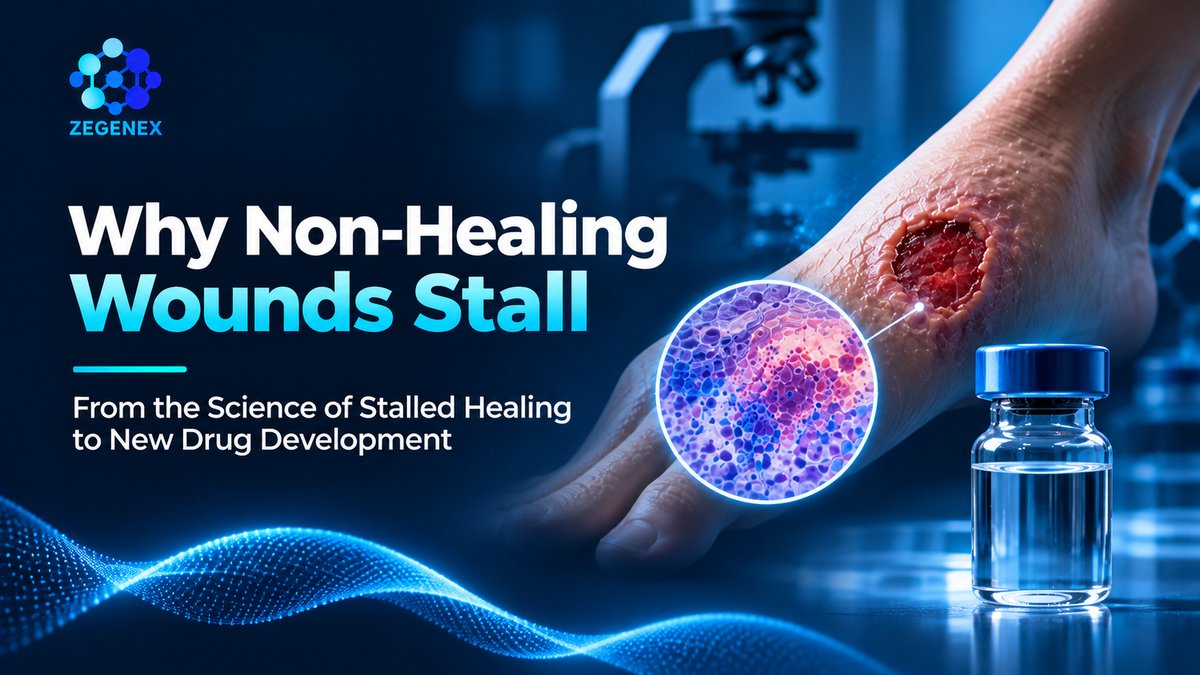
Non-healing wounds often stall because the inflammatory phase fails to resolve, leaving the wound unable to move on to tissue repair. Drug candidates for them are evaluated stepwise: laboratory and animal models first, then safety-enabling studies, an Investigational New Drug (IND) application and staged human trials judged largely on complete wound closure.
This article explains both halves for investors, business-development teams and researchers, in general terms and without success-rate claims.
What Causes a Non-Healing Wound?
A wound becomes non-healing when it fails to progress through an orderly, timely sequence to durable closure. Common causes include persistent inflammation, poor blood supply, infection, repeated pressure and metabolic disease such as diabetes. At the cellular level, many chronic wounds stall in the inflammatory phase.
FDA's guidance on chronic ulcer products defines a chronic cutaneous ulcer in exactly these terms: a wound that has failed to proceed through an orderly and timely series of events to produce durable closure.
The wound healing process, briefly
Normal repair moves from inflammation to tissue formation and then maturation. Inflammation is useful early, clearing debris and microbes. The problem in chronic wound healing is that the inflammatory stage does not end. A 2021 review in Frontiers in Immunology on macrophage-related chronic inflammation describes several reasons:
- Incomplete macrophage switch: Pro-inflammatory macrophages do not fully transition to repair-promoting forms, so the wound cannot advance to the proliferative phase.
- A hostile local environment: High glucose, advanced glycation end products and oxidative stress favor inflammatory macrophage activity.
- Poor debris clearance: Impaired removal of dead cells in diabetic macrophages leaves debris that sustains inflammation.
- Self-reinforcing signals: Inflammatory cytokines can form a feedback loop that keeps macrophages in the inflammatory state.
- Bacterial contribution: Some organisms can prolong inflammatory macrophage activity.
The same review notes conflicting reports on macrophage numbers in diabetic wounds, which may reflect differences in methods, so the biology is not fully settled.
Why Are Wounds Not Healing Quickly?
Wounds heal slowly when several problems overlap: inflammation that does not resolve, damaged or senescent cells, reduced new vessel formation and mechanical or infectious stressors. Because these factors interact, fixing one does not always restart healing, which is why healing chronic wounds is hard to achieve with a single intervention.
Mouse studies in leptin-deficient diabetic models describe prolonged inflammation, impaired angiogenesis, reduced growth factor signaling and increased bacterial colonization, alongside weaker fibroblast activity and matrix production. These findings come from animal models and need confirmation in people, but they illustrate why a stalled wound is rarely a single-defect problem.
For drug developers, that complexity is both the opportunity and the risk. A candidate must act on a biology that varies between patients and wound types, and it must do so in a setting where standard care, infection and pressure also affect outcomes.
How Are Wound Healing Drugs Developed and Tested?
Wound healing drug development starts with laboratory and animal studies to look for activity and toxicity. If results support it, the sponsor files an IND so the FDA can review the proposed human studies. Trials then proceed in phases, and a marketing application is reviewed by FDA only after human data are submitted.
Preclinical diabetic wound healing: models and limits
Preclinical diabetic wound healing work typically combines several kinds of model, each with limits:
- 2D cell assays: Scratch assays measure cell migration in a monolayer. They are cheap and widely used for early screening, but manual scratches are uneven and 2D data often predict in vivo responses poorly, according to a 2023 review of human in vitro skin models in Biomedicines.
- 3D skin equivalents: These engineered tissues are more physiologically realistic and allow richer analysis, but they usually lack functional blood vessels and immune cells, and models of chronic wounds are not yet reliable enough for clinical prediction.
- Rodent models of diabetic wounds: Leptin-deficient db/db mice reproduce delayed closure, persistent inflammation and poor angiogenesis, and are reproducible and widely used. A 2022 systematic review also notes that the model is monogenic, whereas human type 2 diabetes is polygenic, and that mice heal mainly by contraction while human wounds heal by granulation and re-epithelialization.
FDA's guidance adds that there are no ideal animal models for chronic wounds, so sponsors typically use more than one. Reproducible activity across models is therefore a more meaningful signal than a single result.
The FDA pathway, step by step
The sequence below is general. Durations and success rates vary and are not stated here. See also the FDA drug approval process overview.
- Preclinical research: Laboratory and animal studies assess activity and basic safety.
- IND-enabling studies: Additional toxicology, pharmacology and manufacturing work supports the IND application, which describes the drug's composition, manufacture and the plan for human testing.
- Phase I: First studies in people, focused mainly on safety and tolerability.
- Phase II: Early evaluation of activity and further safety in patients with the target condition.
- Phase III: Larger confirmatory studies of safety and effectiveness.
- FDA review: The sponsor submits a New Drug Application; FDA evaluates safety and effectiveness, labeling and manufacturing, and then approves it or issues a response letter.
What FDA looks for: endpoints and FDA approval for diabetic foot ulcer therapies
For chronic ulcers, FDA's guidance has described complete wound closure as the most clinically meaningful efficacy claim. Any FDA approval for a diabetic foot ulcer therapy would therefore be expected to rest on well-defined wound closure data in the stated wound type, with participants receiving standard care. For the wider treatment landscape, see Diabetic Foot Ulcer Treatment in US: Current Options, Gaps and What Comes Next.
One caution: FDA's separate guidance, Diabetic Foot Infections: Developing Drugs for Treatment (final, June 2024), concerns drugs for infection that has not spread to bone or joint. It is not a guidance on drugs to promote wound healing.
What Does Each Milestone Mean for Investors?
Each milestone retires a different kind of risk. Preclinical validation tests whether activity is reproducible, the IND tests whether the package is adequate for human testing, Phase I tests safety, and Phase II gives the first signal of benefit. None guarantees later success, so milestones are better read as risk reductions than as proof.
- Preclinical validation: Reproducible activity across more than one relevant model reduces biological risk, though animal results do not always translate to people.
- IND: FDA's review that proposed studies do not pose unreasonable risk to participants shows the safety and manufacturing package was adequate for first-in-human testing; it says nothing about efficacy.
- Phase I: Safety and tolerability data reduce safety risk and inform dosing.
- Phase II: The first signal on wound closure against standard care, typically in small groups, so results carry statistical uncertainty.
- Typical risks across the path: Translation from animal models to human wounds, heterogeneity of patients and wound types, endpoint design, manufacturing and the time and capital needed to advance.
Wound healing drug development is also shaped by trial design. Registered studies on ClinicalTrials.gov show how sponsors define eligibility, standard care and endpoints, and they are a useful primary source for investors comparing programs. For how therapy classes compare, see Chronic Wound Treatment Options Compared.
Frequently Asked Questions
Why do some wounds never heal?
Often because inflammation does not resolve, so the wound cannot move on to tissue repair. Poor blood supply, infection, pressure and diabetes can add to this.
What is the first step in developing a wound healing drug?
Laboratory and animal studies that look for activity and toxicity, followed by IND-enabling work before any human testing.
What does an IND do?
It lets FDA review the proposed human studies and the drug's manufacturing and safety data, to confirm that participants are not exposed to unreasonable risk.
What endpoint does FDA emphasize for chronic ulcer drugs?
Complete wound closure has been described as the most clinically meaningful endpoint in FDA's guidance.
Is the FDA diabetic foot infection guidance about wound healing drugs?
No. It addresses drugs for diabetic foot infections without bone or joint involvement, not drugs to promote wound healing.
About ZegeneX
ZegeneX is a Pittsburgh-based, preclinical-stage biopharmaceutical company built on University of Pittsburgh research into zebrafish regeneration biology (read the research background). It is developing Zegen-X5, an investigational, preclinical, shelf-stable small-molecule topical therapy being evaluated for diabetic foot ulcers and other hard-to-heal wounds. Zegen-X5 has not been approved by the US FDA.
Related reading: Molecular mechanism | ZegeneX clinical pipeline | University of Pittsburgh startup wants to innovate wound care with zebrafish
This article is for informational purposes only and is not medical advice.
Sources
- Macrophage Related Chronic Inflammation in Non-Healing Wounds, Frontiers in Immunology 2021
- Wound Healing Impairment in Type 2 Diabetes Model of Leptin-Deficient Mice: A Mechanistic Systematic Review, Int J Mol Sci 2022
- Human In Vitro Skin Models for Wound Healing and Wound Healing Disorders, Biomedicines 2023
- FDA, Chronic Cutaneous Ulcer and Burn Wounds: Developing Products for Treatment
- FDA, Diabetic Foot Infections: Developing Drugs for Treatment (final, June 2024)
- FDA, Drug Approval Process overview
- ClinicalTrials.gov (registry of clinical studies)
Translational Innovation from the University of Pittsburgh
ZegeneX Therapeutics is advancing first-in-class small-molecule regenerative wound healing therapeutics licensed from the University of Pittsburgh to eliminate avoidable diabetic amputations worldwide.